Wednesday, April 28, 2010

Lawson's Story

In a place such as West Africa, where access to constant healthcare is minimal at best, our main max fax surgeon says it's always better to have a malignant tumor that kills you quickly.  Without healthcare, the slow-growing benign facial tumors lead to a horrible death by suffocation.  Lawson was one of the first patients to come through during this outreach, and the ship arrived just in time to spare his life.  Here is Lawson's story, written by Elaine on the communications team. 

His gentle eyes betrayed his desperate hope. “I came here so I could get help,” said Lawson, struggling to speak clearly. A large growth stretched his mouth and cheeks horribly, causing his teeth to stick out in all directions. It had been growing for four years, inhibiting his breathing, eating, and speech, and eventually, his ability to work.

The tumor destroyed his life, separating him from everyone and everything he loved. The people in his village would not sell him food because they said he was a devil. His wife left him, leaving behind their three children. Without work or food, he could not provide for his family.
So, Lawson, once one of Ghana's most prominent soccer players, now hid inside his house.

Then, a radio announcement said that a hospital ship, the Africa Mercy, would soon be coming to Togo offering surgeries free of charge. Daring to hope, Lawson left his children in his mother's care and went to the patient screening.

Lawson was literally at the brink of death as the tumor slowly suffocated him. He was immediately admitted to the hospital ship, with surgery the next day. It took three doctors eight hours to remove the benign growth and repair his nose, upper lip, and cheek. The large amount of blood required during surgery was donated by crew members.

Lawson was overjoyed when he touched the bandages on his cheek. There will be more surgeries within the next year to complete the reconstruction of his face, but the immediate result saved and restored his life.
 
Unable to hold back tears of joy, a delighted Lawson exclaimed, “I can't believe what has happened to me. It is a miracle! My way was crooked, but now my way is straight. Now, I am a man!”

 Lawson can hardly wait to surprise his family with his transformation. He is anxious to eat real food again especially his mother's ademe, a stew made with legumes, fish and red oil. Then he will think about starting his new life.

He has photos of what he looked like before surgery and after. “I want to show pictures to everybody, so people can see what Mercy Ships did for me. Everybody who sees me, they will be surprised,” he grinned. “I survived! Praise the Lord! Hallelujah! Amen!”

Friday, April 23, 2010

The Hunt for Moringa

Directly translated from its Togolese name "yovo-vi-ti," it means the little plant from the white man.  Its leaves have been used for centuries to treat malnutrition and various illnesses, and many NGO's throughout Africa promote its nutritional benefits through local education programs in the community. Hospitals and pharmacies sell the leaf powder to patients.  It grows readily along the roadside and is found in the market.  People use the trees as fences, and the leaves in stews and sauces. 
So what it is?  Moringa is a plant native to India that now grows in West Africa.  Similar to spinach, the Moringa leaves are high in certain vitamins and minerals such as Vitamin A and Iron.  But unlike spinach Moringa is also very high in protein - good quality protein (eight of the nine essential amino acids!) which is quite unusual for a plant food.  I first heard about Moringa in December when the hospital manager suggested we look into using it on the ship with our patients regularly, as it was already being used sporadically in the baby feeding program.

This week, I went out with the agriculture team to visit a Moringa farm.  My thought was that if we could work with one of the local NGO's that grows it in good conditions and sells it in the market, we could potentially purchase it to give to families.  So many mothers here don't have the financial means to purchase formula, so babies get porridge - a mix of flour, milk and sugar that they introduce after or in addition to breast milk.  However, milk, sugar and flour don't provide a whole lot of nutrition for a growing baby, so NGO's throughout Africa have been encouraging mothers to add the Moringa powder to the porridge to provide better nutrient coverage for these growing babies.    
Our agricultural specialists Ken and Jean Claude and I headed out to the local village of Tsevie earlier this week to check out the Moringa farm.  In true Mercy Ships fashion, we were stopped multiple times by Africans whistling us to the side of the street as our Mercy Ships land rover trudged along down the dirt road.  "When are you coming?  Can you help me with my cataracts?"   Handouts were provided (always important to take along when Mercy Ships branded) and we went on our way. After two phone calls and multiple stops to ask if we were headed in the right direction, we sped past Cristof waving us down on the side of the road.  Cristof is our Moringa contact and works with the Center for Ecology and Development through the Mercy Ships Agriculture Program Food for Life.   He grows the Moringa in a co-op here with about twenty other Africans who farm the land.  Below is Cristof holding a Moringa leaf on the farm. 
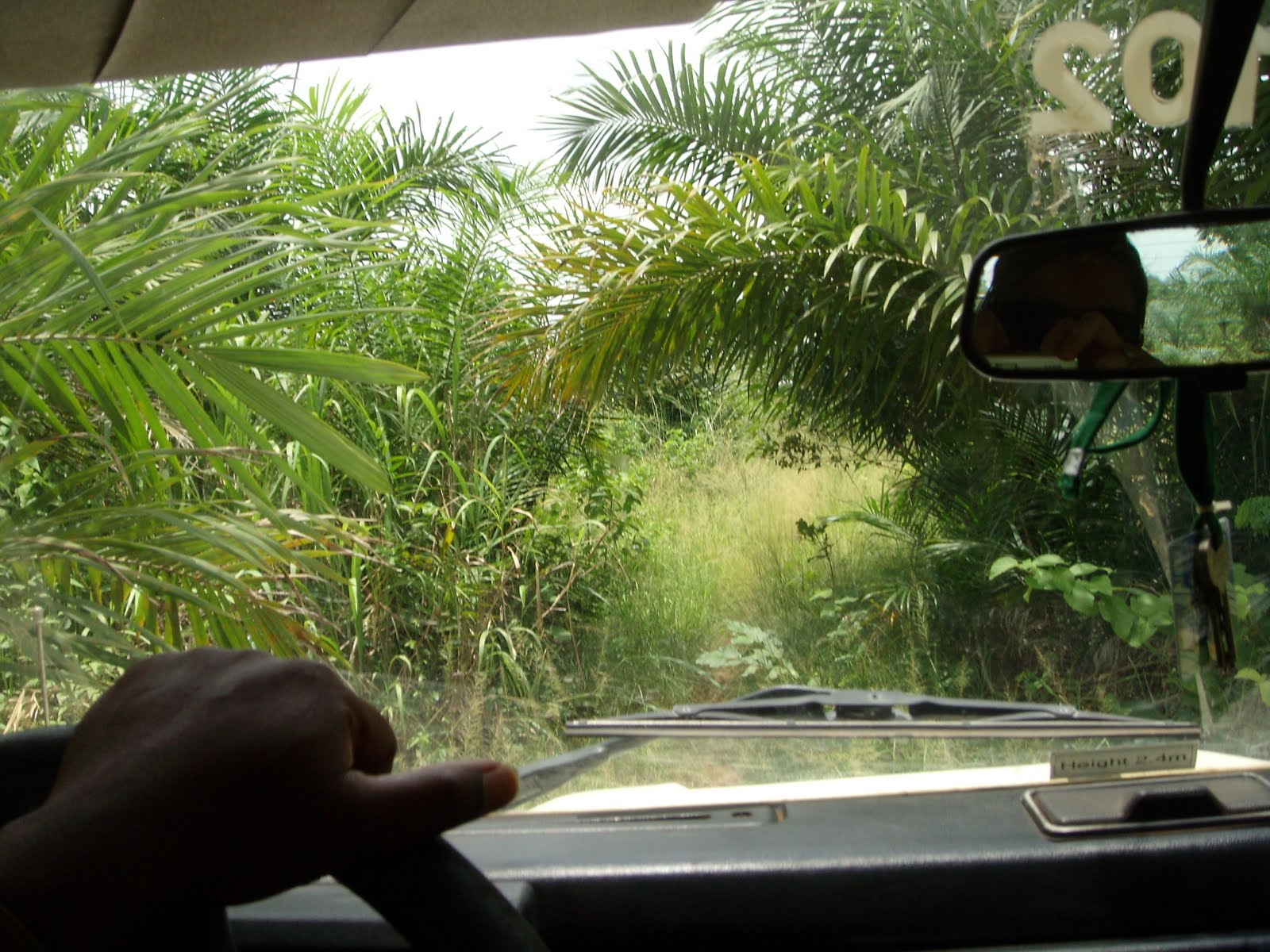
But before we got to see the Moringa we made a quick pit stop at his house.  There were a few people to screen that heard we were coming through the village. Here we were, two agriculture specialists and a dietitian, looking at surgical candidates!  Ha! After some quick histories and photos we were on our way to the farm.  This is the road (or lack thereof) that we took to get to the farm.  It was basically a dirt path made for a bike, and the land rover had no problems plowing through the bushes and trees. 
I learned that the Mercy Ships agriculture program teaches the local farmers many things.  They teach them how to rotate crops, and how to keep the soil nutrient-rich year after year.  The general practice in Africa is to burn the land at the end of the harvest season which robs the soil of nutrients.  Here is a burned area on the way to the co-op:
Below is an area that hadn't yet been burned.  They will be growing pineapples on this part of the land. 
The Africans use machetes to chop down the growth into farmable land. You can see the area that has already been cleared in the foreground and the yet-to-be-chopped area behind.  Sometimes Africans have the stereotype of being lazy - especially the men, but let me tell you the Africans working out in the field in the hot sun were as far from lazy as you can get! I have never been so hot in my life. While I come from Arizona where it can get pretty dang hot, this is a new level of hot here in Africa.  I lost multiple liters in sweat at the farm and I cannot even begin to imagine working in this humidity and sun day in and day out.  Thank goodness for shade huts!
Then we traveled to see where the Moringa is dried.  It must be dried in the shade to prevent nutrient loss.  The leaves are then ground, packaged and sold in the market in Lome two hours south.  Basically it's like dried high protein vegetable leaves.  Here are Cristof, Jean-Claude and I outside the drying house.
On the way out we went through a pineapple farm....
...and ate some pineapple off the core! In my hand is also a Moringa pod.  You can take the seeds out of the pod to plant new trees.
After a long day at the Moringa farm we came away with this final product:
the dried Moringa powder. Perhaps it looks a tad bit questionable in these unmarked bags. Actually, when one of our doctors from TX came to the ship with Moringa in hand, we heard he got an earful at customs!  In addition to the powder itself, I also came away with a new appreciation for rural farming.  I had no idea how much effort goes into making these fields farmable, and how hard these Africans work.  The African way of life here is so interesting, and every day I learn something new.  In a country where malnutrition is so prevelant, I think there is exciting potential for what lies ahead in regard to Moringa application.   More to come on that soon.... 

Friday, April 16, 2010

Friday's Favorite: Got Milch?

One of my friends Ryan recently left the ship, and his trademark was his constantly witty attire in the form of t-shirts.  In discussion one day, those of us sitting at dinner decided to order some shirts with our own saying "Got Milch?"  This was a pun on the "Got Milk" campaign back in the states, because here on the ship we don't have that cold, calcium-rich American goodness.  We have a more highly pasteurized Dutch milk in a box called milch, which just doesn't do the trick.   Thinking we were so creative, we ordered our Got Milch shirts and were excited when they arrived recently.  Julle, Estelle, Haley, Leah, Allison and I all decided to all wear them together last week and took a few photos. Here are Leah and I with our milch in a box.
 However, after one day of wear we realized that the words Got Milch were placed strategically across our chests.  On more than one occasion, people asked us if we were promoting breastfeeding for the feeding program on the ship! Ha!  
Here on the ship we live with 400 other people from around the world.  The take home lesson this week was that the next time we decide to order a t-shirt, we'll have to remember that sometimes cultural slogans don't transcend internationally =) 

Saturday, April 10, 2010

Easter Brunch!

When I went home over Christmas, one of the best things about being back in the states was the crazy selection of food.  Here on the ship the food is really good, but after a while you get used to the same meals again and again so a little variety is always nice.  In honor of Easter last weekend the galley cooks went above and beyond.  Check out the Easter fruit spread!
We had fresh fish, french toast, eggs benedict, potato scramble, croissants, rolls, and the list goes on and on.  My favorites though were the watermelon fruit boats and apple swans
...and who doesn't want an apple swan on Easter!    When life here on the ship can sometimes be monotonous after a while, we always say it's the little things that make a huge difference.  I am so thankful that we have such amazing cooks here on the ship, as they definitely made our Easter day of celebration extra special!

Monday, April 5, 2010

Friday's Favorite...just a little late

This picture is my Friday's Favorite this week.   Africans checking out the white man and his crazy pants...err shorts.   I love it! 
This was the start of our camping experience two weeks ago.  Sixteen of us headed to Kpalime, a town about two and a half hours north of Lome that seems to be popular destination these days for Mercy Shippers. With plenty of waterfalls and good hiking, we partook in the Kpalime trend.  We arrived to our destination to set up camp just yards away from many of the small surrounding African communities.  
After setting up camp in the African village, we hiked a small mountain with our guide.  Here we are, all sixteen of us at the top.
   
This is also where Leah learned to balance a pineapple on her head!
Our guide showed us the grasshopper with the "African Mask"..pretty crazy!
And since I moved cabins in January here is our first out-of-town roomie pic: Leah, me, Sandra and Suey!

We returned back to the campsite to get dinner as the rain was headed in. I saw one of the African ladies doing her routine walking the goats (which she did multiple times while we were visiting)!
Since we were practically in their village, we invited our hosts to hang out for the evening.  They ate with us in their true African way (spaghetti with your hands)...
played games with us
and danced with us late into the evening complete with bongos and song - even those who you'd think would be in bed at that hour!
Look at this cutie hanging out with us in her pj's.  With no running water, the kids were all so dirty, but so precious!
The next morning we awoke to the chickens ready to start their day at 5am.  Or, if we weren't awakened by the chickens, then we awoke to some African friends who wanted to play bright and early with us and with the bongos.  Check them out trying to wake up the neighboring tent!
 Day two involved our trip to the falls.  After our fresh fruit breakfast provided by the village locals, we walked with our guide and arrived to this:
where we had some fun playing in the water
(Juan looked too ridiculous to pass this one up)
...and we posed for a group shot (please note Tom on the upper left who missed out on the group photo by climbing the falls.)  We had such a great time not only at the falls but just spending time in the village with the Africans and learning the way they live.
There is a quote that says "a mind once stretched by a new idea never regains its original dimensions."  Every weekend away continues to shift my paradigm and this weekend was no exception.  So much of the world lives with so little - no clean water, no electricity, and no solid walls to surround their homes.  These are basic necessities that we so easily take for granted in the west.   We can read all we want or watch the documentaries on TV, but until you come for yourself and experience life on less than a dollar a day you don't fully comprehend the impact it has on you.  I came to Mercy Ships thinking I was giving up so much of my comfortable life in the US to help the forgotten poor on this big hospital ship. But here on the ship, I still get my three tasty meals a day, a shower at my convenience and healthcare if I need it.  Despite just a glimmer of this daily life in the African village, I know I still have so much more than these Africans will ever see or imagine in their lifetime, and that is a very humbling thought.    

Tuesday, March 30, 2010

When You Can't Trace His Hand

At home back at Phoenix Children’s Hospital, every day I dealt with kids that died. I remember the day my first patient died after transplant and I went home and just sobbed, despite the fact that I barely knew her. But in time, with each passing death I encountered, I became somewhat immune. My heart couldn’t handle all the grief and I somehow began to block out the emotion after I’d seen so many children die.

So when I signed up to work with an organization that brings hope and healing to the forgotten poor, I wasn’t expecting a lot of death here onboard the Africa Mercy. More than that, I wasn’t expecting to get attached. Most patients that come through the ward on Mercy Ships come in and out in a matter of weeks. But Anicette and her reluctant little body just didn’t want to gain weight, and she was here for months in the infant feeding program last year. She was loved by everyone and we all got to celebrate in her achievements together. You can read about her in my previous blog post here. After many months of slow growth, she finally had her surgery to repair her cleft lip in November. Here she is just a few days before surgery - a chunky monkey!  We got to see her Mama care for and love this child so much. Anicette was transitioning off her specialized formula and doing great, so she was sent on her way, with the hope to return in 2010 for cleft palate surgery.

So it was quite the shock when she returned to us on Friday from Benin, emaciated beyond imagine and barely recognizable. As I picked her little body up I wanted to cry. I told her mama Zenabou that she did well for bringing her back to us. I hoped with all my heart that we could get her back to what she was when she left us in November.  Clearly there was something very wrong with her little body and its inability to digest nutrients, as she’d been throwing up and having diarrhea for weeks. I hoped we would have the capability to send away for specialized tests to work up whatever metabolic issue it was. I hoped to make a case to the formula company for her incredibly expensive specialized formula that worked previously onboard– a hope that she could get the formula for years to come if needed. Perhaps a large feat for a child living in Africa, but nothing is impossible with God.

But I didn’t get that chance. Yesterday, the overhead pager went off “Emergency Medical Team to A Ward” and my heart sank. I thought “please God we have a full code palliative care patient on A ward. Don’t let it be Anicette.”

But this little bundle of love went to be with Jesus yesterday. Her frail body couldn’t take it anymore when her airway became compromised and she was too weak to fight. I watched her mama Zenabou with wailing sobs as the nurse took her away from the commotion of trying to resuscitate her, and my heart broke.

As the doctor onboard said yesterday, while God didn’t intend for this, he did allow it. Our goal isn’t always to heal people. Sometimes it is to make the effort to help them in the best way we know how. Sometimes that results in death and sometimes in new life.

When Anicette died yesterday, Zenabou explained that Ani was her second baby she’d lost. Her other baby just couldn’t eat she said.  None of us knew she had been through this before.  Currently Zenabou is pregnant for the third time. So after asking for prayer for Anicette yesterday, today I ask for prayer for Zenabou. Pray for a miraculously healthy pregnancy. Pray that the baby in her tummy wouldn’t be born with the same problem that her other two children had. That she would be welcomed back into a village where she was previously cast out for having a child with a deformity. That despite her huge loss and grief, pray that Zenabou would feel overwhelming love and peace that surpasses all understanding.

“God is too good to be unkind. He is too wise to be mistaken. So when you can’t trace His hand, that’s when you must learn to trust His heart.”

Sunday, March 28, 2010

A Prayer Request

They came to a local church in town this morning, a church known for the presence of Mercy Shippers. We are the white people with the means available to help, she said. She had heard that we were there, and although she doesn’t attend church herself, she didn’t know what else to do. So on the gangway I saw them, brought from the church to the ship. The characteristic picture of the emaciated child with the sunken in eyes, drowning in his little African outfit in his mama’s arms. She cried out in frustration when we tried to get a history of what was going on. “Nothing is working. My milk is drying up, and he is too weak to suck. He throws up what food I can give him and he can no longer walk. My husband has kicked us out because my child is cursed. I have no money to take him elsewhere. Please help me.”

There is a woman downstairs in the ward with bruises on her back; bruises from her husband who beats her and her children because she doesn’t have the means to bring in enough food for the family. She speaks to me so cautiously, and questions why I am asking about the food her malnourished child gets at home, leery of divulging too much information.

Or take Anicette, the poster child for the Mercy Ships feeding program last year in Benin. She traveled over the border with her mama this week to visit us here on the ship. It wasn’t a visit to say hello and tell us how well Ani was doing; she traveled cross country because she didn’t know what else to do. At fourteen months old, Ani has regressed to the weight of a one month old. Mom saw a picture of Anicette plump and happy on the door of the feeding program exam room, a realization of sad irony as she walks in with Ani, now skin and bones and crying in her arms.

I’ll be honest. This was a tough week. Despite all the joys that occur on board and how happy I am to be working in the ward, there are weeks like these where I just want to wrap up these families and take them home with me to the states. I want to take them to a safe place where fathers go to jail for beating their wives and where children get subsidized foods to keep them growing strong; a place where I know help is available for the long term.
 
But here in Africa that is not always the case. The sad reality is that there are only so many feeding programs in the country and more than that, when these kids are only moderately malnourished they may not even qualify for help. Sometimes I feel like my hands are tied when I’m seeing a child for malnutrition, but the only problem is they lack the finances to buy food.  If we can, we keep them here on the ship to fatten them up. Or we give them formula or money and send them on their way, hoping and praying that God will intervene for the long term. Despite the sad circumstance, I still trust that God is in control and He knows what is going on in each and every life here.

With all the resources available at home in the states, it was a lot easier to find the answers myself. But here, where the answers aren’t always obvious, I have to trust in God and have faith that God can and will provide if I ask audacious prayers beyond what I know is capable of happening. So I seek him and trust him and ask for his help every single day. Along with me, please pray for this little baby that came to the ship today with his mama that we couldn’t keep on board. Please pray that they make it to the feeding program in town and we gave them enough money to get situated there and grow. Pray for good care at the local hospital, which I’m learning, is often hard to come by. Also pray for the family with the abusive husband. Pray that this mama would be brave enough to seek help elsewhere and that these kids would gain weight while here. Finally, pray for Ani. Pray that she grows strong here on the ward as we figure out what went wrong and correct this problem now, so when the ship leaves again, she thrives.

Please also pray for me. I truly love the work that I am doing here in Africa and despite these sad events, I know that God has placed me here for a reason. I’ve invited the head of nutrition from the Ministry of Health to the ship tomorrow. I want to show him what we do onboard and collaborate with the local Togolese feeding programs already in place. So far, my contacts at UNICEF haven’t been able to offer much, so I am hoping and praying that he has something more encouraging to say. Please pray that Mercy Ships is able to help with the lack of infrastructure that exists in this regard.  As I’ve seen before, we serve a big God that can provide in really crazy ways. Give me some time, and I’ll tell you what He’s doing here in Togo with us.

“Now to him who is able to do immeasurably more than all we can ask or imagine, according to his power that is at work within us, to him be the glory.” Ephesians 3: 20-21